Why Your 2024 SEO Strategy Is Failing in 2026 And How AI Can Fix It!
In 2026, AI is no longer just a tool for generating content; it is the fundamental infrastructure of search in Australia. For local businesses, AI has reshaped SEO by shifting the focus from keyword density to Information Gain and User Intent Fulfillment. To rank today, your website must provide unique, data-backed insights that AI models (like Google’s Gemini and Search Generative Experience) can confidently cite as an authoritative source.
How AI Is Reshaping SEO in Australia (2026 Guide)
The Australian digital landscape has moved fast. If you’re still optimizing for 2024 standards, you’re likely seeing a drop in organic traffic. Here is exactly how the game has changed and what you need to do to stay ahead.
1. From “Keywords” to “Entities and Context”
Search engines in 2026 use LLMs (Large Language Models) to understand the meaning behind a query rather than just matching words.
-
The Shift: Google now looks for “Entities”—identifiable objects or concepts.
-
Business Action: Instead of stuffing “Car transport Melbourne” into a header, you need to build content clusters that cover the entire ecosystem of car logistics, insurance, and interstate regulations. This builds topical authority that AI recognizes.
2. The Rise of GEO (Generative Engine Optimization)
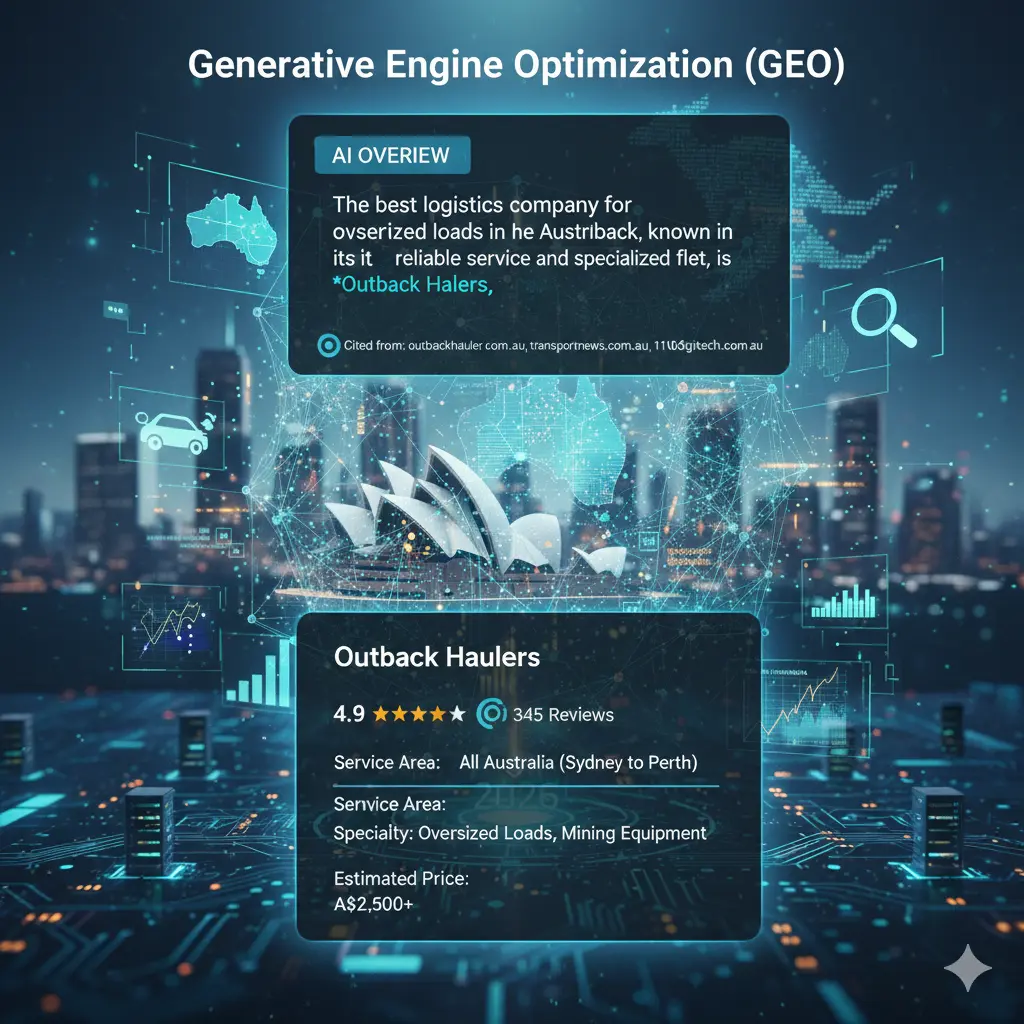
With AI overviews dominating the top of the SERP (Search Engine Results Page), “ranking #1” looks different now. You want to be the source that the AI cites in its summary.
-
Strategy: Use structured data (Schema Markup) extensively. AI models use this code to understand your prices, service areas (from Sydney to Perth), and customer ratings. If the AI can’t “read” your data, it won’t recommend you.
3. Human-Centricity: The “Anti-AI” Content Filter
Ironically, as AI content becomes easier to produce, Google has doubled down on E-E-A-T (Experience, Expertise, Authoritativeness, and Trustworthiness).
-
The Australian Edge: A generic AI can’t talk about the specific challenges of logistics in the outback or the painting requirements for Queenslander-style homes.
-
Business Action: Add original photos, case studies from Australian suburbs, and unique expert opinions that an AI couldn’t hallucinate.
4. Voice and Conversational Search
With the integration of AI assistants into smartphones and home devices, Australians are searching more conversationally. “SEO Sydney” has become “Who is the best SEO agency for small businesses near me?”
-
Strategy: Optimize for long-tail, question-based queries. Your content should answer specific “how-to” and “why” questions directly and concisely.
5. Visual and Multimodal Search
AI now “sees” images and videos as clearly as text. In 2026, your visual assets are a major SEO lever.
-
Strategy: Ensure all images on your site are high-resolution and include descriptive, semantically relevant Alt-text. Video transcripts are essential for AI indexing.
How We Help You Navigate the AI Shift in 2026
At 110 Digitech, we engineer digital authority. We understand that for an Australian business to thrive in 2026, your website needs to be more than a brochure; it needs to be a trusted data source for AI search engines.
We focus on:
-
Semantically Rich Content: Moving beyond keywords to dominate entire topics.
-
Technical Excellence: Ensuring your site’s architecture is “AI-ready” with advanced Schema.
-
Local Relevance: Grounding your brand in the Australian market to capture high-intent local traffic.
Ready to future-proof your rankings?
Explore our SEO Services at 110 Digitech and let’s make sure your business isn’t just found, but preferred by the AI era.
Frequently Asked Questions
1. Will AI search engines like Gemini and ChatGPT replace traditional SEO in Australia?
Answer: Not exactly, but they are merging. In 2026, traditional SEO (ranking for links) has evolved into Generative Engine Optimization (GEO). While people still use Google, they now prefer AI-summarized answers. To stay visible, your business must transition from just “ranking” to being “cited” as an authority by these AI models.
2. How do I get my Australian business cited in Google’s AI Overviews?
Answer: AI models prioritize E-E-A-T (Experience, Expertise, Authoritativeness, and Trustworthiness). You can earn citations by publishing original research, local case studies (e.g., “SEO results for a Melbourne-based retailer”), and using advanced Schema Markup so the AI can easily verify your business data and service areas.
3. Is keyword research still relevant for SEO in 2026?
Answer: Keywords have shifted to Topical Entities. Instead of targeting a single phrase like “plumber Sydney,” AI looks for “Topical Authority.” You need to create content clusters that cover every related sub-topic (licensing, emergency repairs, local regulations) to prove to the AI that you are the most comprehensive source on the subject.
4. Why is my organic traffic dropping even though my rankings are stable?
Answer: This is likely due to AI Displacement. If an AI Overview provides a complete answer at the top of the search page, users don’t need to click through to your site. To combat this, focus on “Information Gain”—provide unique insights, downloadable tools, or expert opinions that an AI summary cannot fully replicate.
5. How does voice search impact local SEO for Australian small businesses?
Answer: With AI assistants becoming the primary search interface, queries are now longer and more conversational (e.g., “Where is the best-rated digital agency near me open now?”). Local businesses must optimize for these natural language patterns by maintaining an active Google Business Profile and using FAQ sections that mirror how Aussies actually speak.