How Long Does SEO Take to Show Results? Find the Answer Here
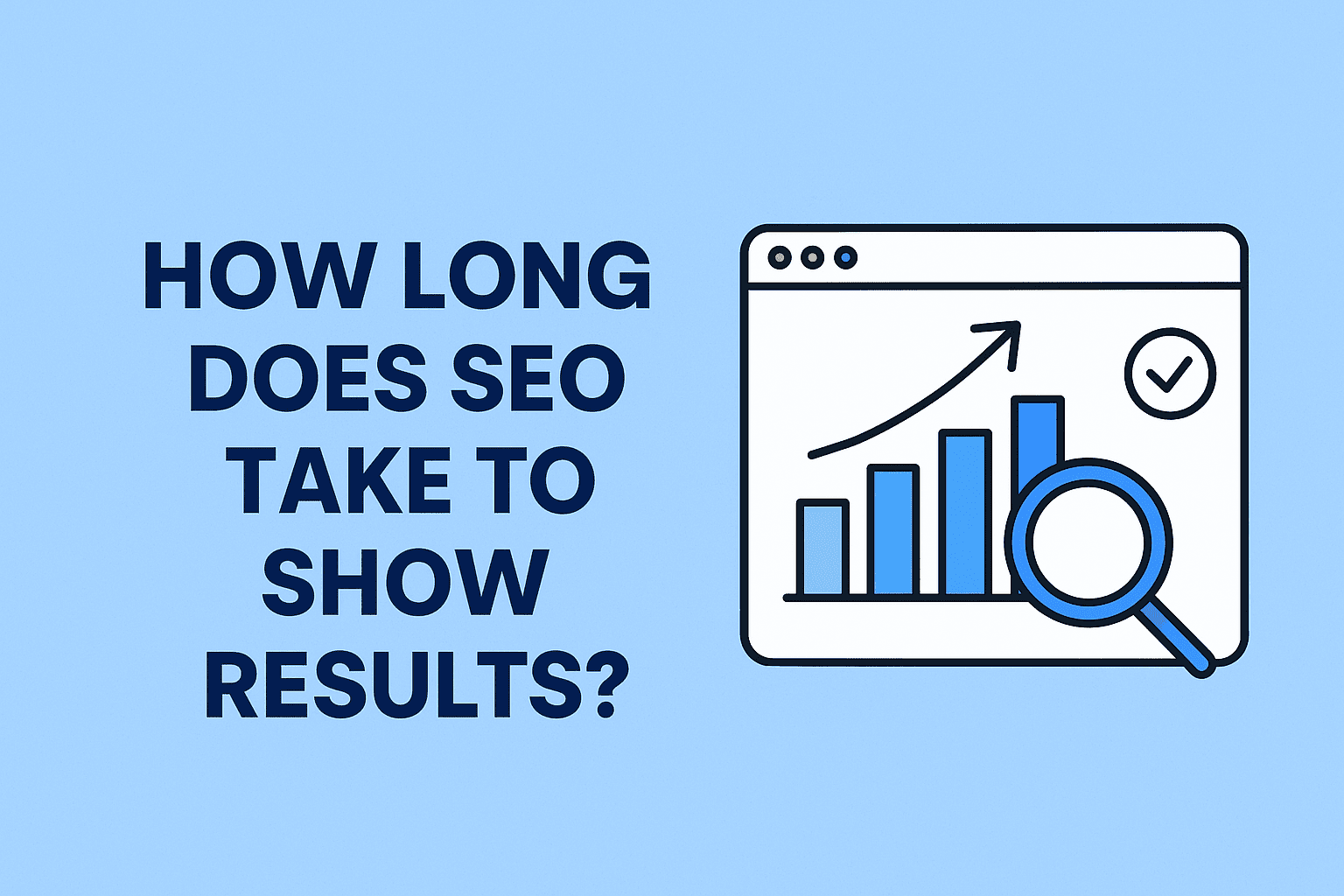
SEO is one of the most common marketing questions: “How long until I see the SEO results?” The truth is, there’s no fixed answer, but data from reliable sources gives a realistic view.
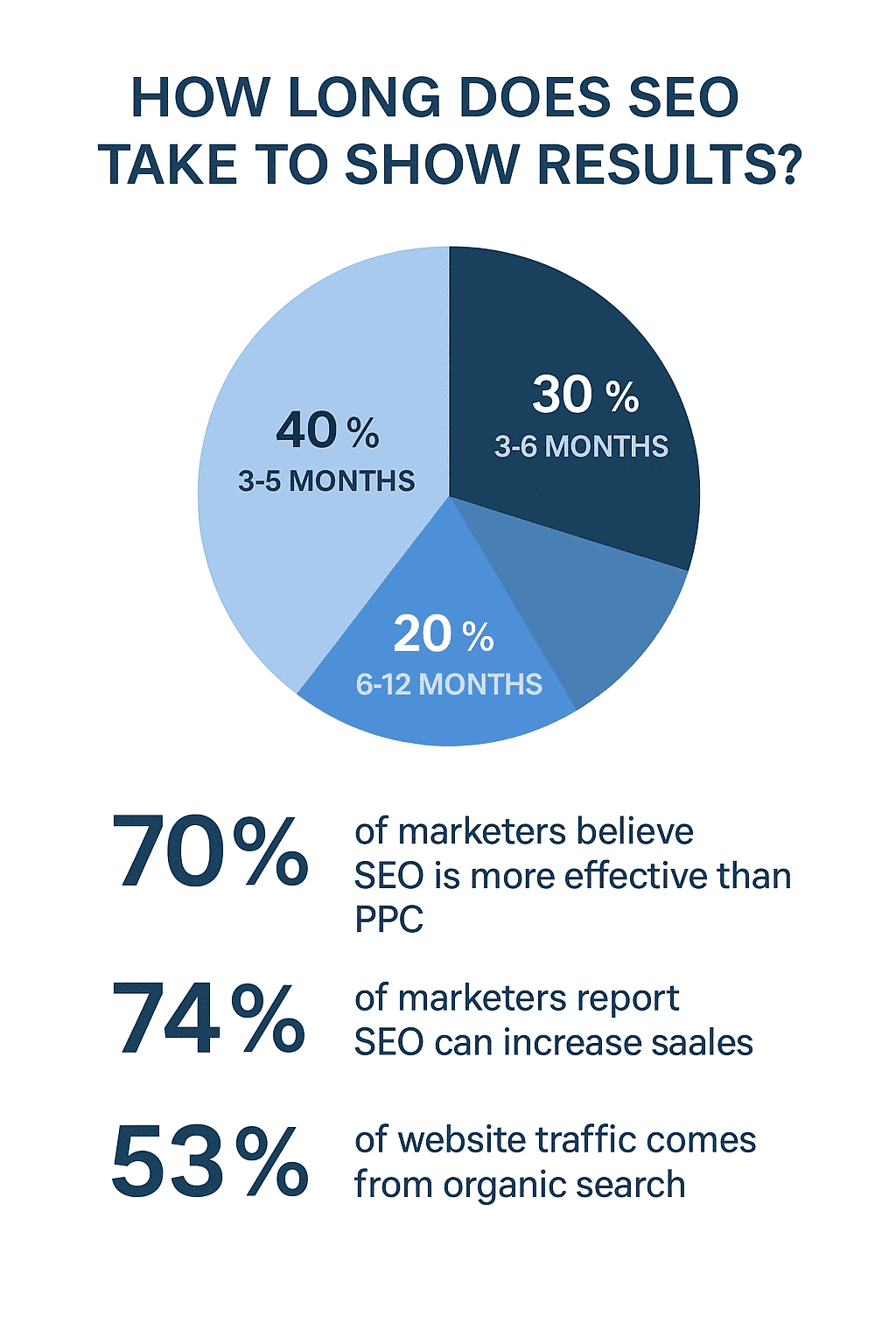
- According to Databox, many campaigns begin producing measurable improvements after about 3–6 months—especially when technical optimisation, content, and link-building are consistently applied.
- WebFX reports that while some visibility shifts can appear sooner, most businesses won’t see stable, meaningful growth until 4–12 months after full implementation of SEO best practices.
- A survey of 75 SEO experts by Morningscore found that approximately 94.6% expect to see the first signs of results within 6 months. However, early wins may appear between months 2–4 under favourable conditions.
In this post, we’ll cut through the “it depends” by laying out the typical timeline, key factors that speed up or slow down your results, and how partnering with an expert digital agency can help you achieve meaningful SEO outcomes faster.
Key Factors That Affect How Long SEO Takes to Show Results
There’s no universal SEO timeline to grow your website faster; it depends on how competitive your industry is, the quality of your website, and the consistency of your optimisation efforts. Below are the primary factors that determine whether you see results in 3 months or 12 months.
1. Website Age and Authority
Older domains with a consistent history of publishing quality content often see results faster.
New websites, on the other hand, must first establish trust and authority in Google’s eyes, a process that can take several months to accomplish.
According to Ahrefs, only 5.7% of newly published pages appear to Google’s Top 10 results within a year, highlighting the significant role that domain maturity and authority play.
8. Budget and Resource Allocation
Your SEO budget directly affects how fast you see results. A larger investment means more resources for content creation, technical optimisation, link building, and professional strategy execution.
- Low budget (DIY or small campaigns): Expect 6–12 months for visible results.
- Medium budget (agency partnership): Results typically appear within 3–6 months.
- High budget (enterprise SEO): Can yield traction in 1–3 months with strong infrastructure and automation tools.
- Data Insight: SEMrush notes that businesses investing over $2,500/month in SEO see 2x faster growth in organic traffic compared to those spending less than $500.
The more strategically you invest in SEO expertise and tools, the faster you’ll accelerate through the growth curve.
2. Quality and Depth of Content
Google’s Helpful Content System rewards websites that consistently deliver original, relevant, and in-depth information.
Thin or surface-level articles take longer to rank or fail at all because they don’t match search intent or provide enough topical coverage.
High-performing sites publish comprehensive, entity-rich content that covers subtopics, FAQs, and related questions in natural language.
3. Technical SEO Health
If your site has crawl errors, slow load times, or poor mobile performance, even the best content won’t rank.
Search engines rely on efficient crawling and indexing, which means that technical SEO is the foundation of faster results.
Semrush data shows that pages with a PageSpeed score above 90 have a 15–20% higher crawl frequency, which improves the speed of ranking updates.
4. Backlink Quality and Velocity
Links are still a major ranking factor. However, it’s not about quantity; it’s about relevance and authority.
A consistent backlink growth pattern from trusted, industry-specific sources signals credibility and accelerates results.
Moz’s Link Explorer highlights that websites with firm link profiles experience measurable visibility improvements 30–40% faster than those with weak or spammy backlinks.
5. Competition and Keyword Difficulty
Ranking for “digital marketing agency” will take longer than ranking for “digital marketing agency in Adelaide.”
Keyword difficulty, measured by tools like Ahrefs KD or Semrush Keyword Difficulty Score, directly correlates with the time investment needed.
Long-tail, location-based, or niche keywords often bring quicker wins while building momentum for more competitive terms later.
6. Frequency and Consistency of Optimisation
SEO is an ongoing process. Websites that continuously update content, earn backlinks, and monitor analytics maintain momentum.
According to Search Engine Journal, sites that post fresh content weekly are 2.5x more likely to maintain top 10 rankings long-term.
Realistic SEO Timelines: What to Expect Month by Month
Even with a perfect strategy, SEO takes time. Search engines must crawl, index, and evaluate your site before they establish trust.
Here’s a breakdown of what most businesses can expect based on aggregated data from Ahrefs, Semrush, and Search Engine Journal.
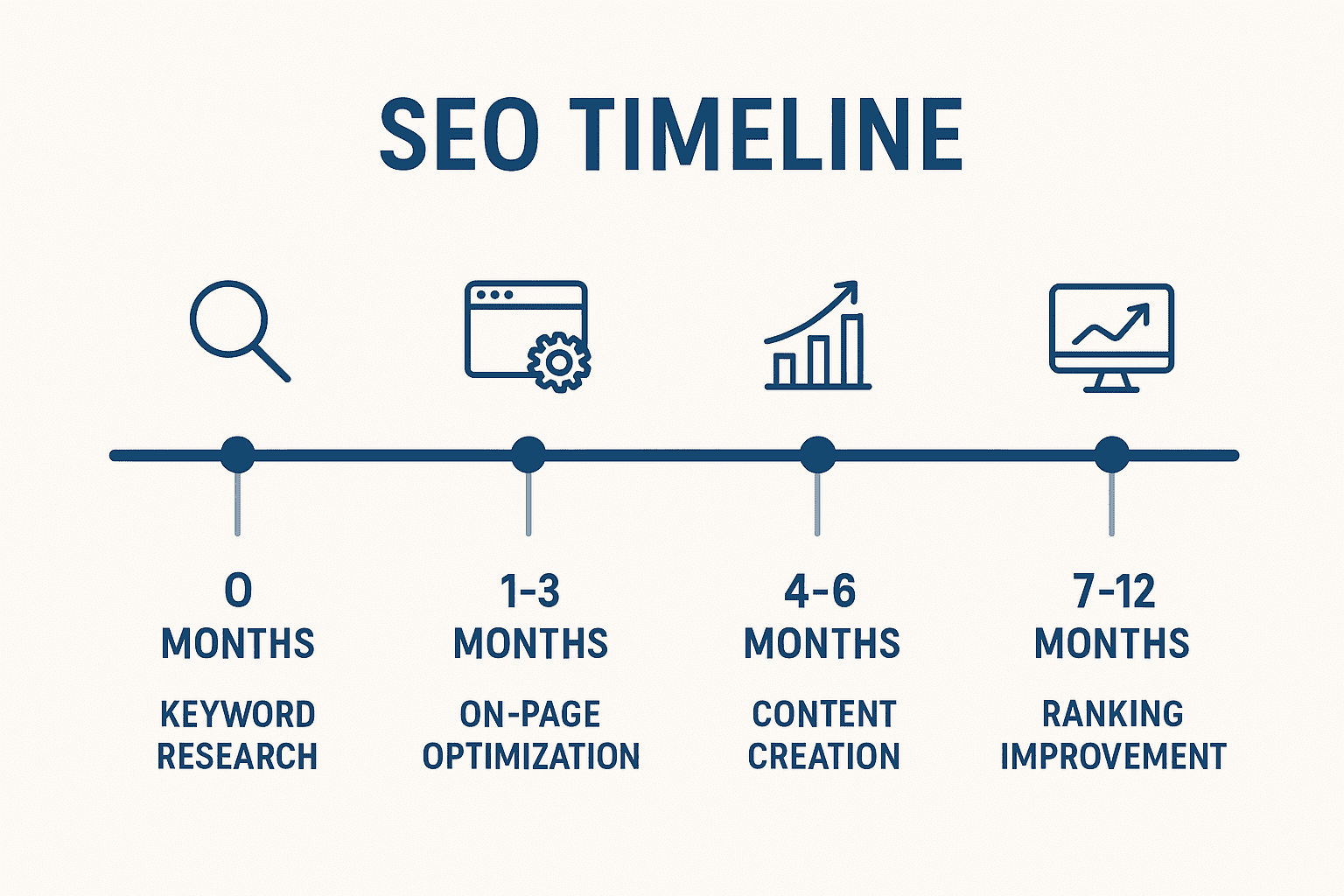
Month 1: Research, Audits, and Technical Fixes
The first month focuses on analysis and foundation-building:
- Conducting complete technical and content audits
- Keyword mapping and competitor benchmarking
- Fixing critical crawl issues, site structure, and indexing errors
Expect: Minimal ranking change but significant groundwork.
Once technical errors are resolved, pages become crawlable and eligible for indexing, setting the stage for improved visibility.
Months 2–3: Content Optimisation and On-Page Implementation
This is where on-page SEO and content production begin to show early signals.
- Updating existing pages with intent-focused keywords
- Publishing optimised blog posts
- Implementing internal linking and structured data (schema markup)
You may start noticing initial ranking improvements for long-tail or low-competition keywords during this period.
According to Databox, 68% of SEO experts report that early ranking movement typically begins within this window. However, results vary by niche and authority.
Months 4–6: Authority Building and Traffic Growth
At this stage, content gains traction, and backlinks begin to influence domain authority.
- Outreach for guest posts and digital PR
- Continuous optimisation based on Google Search Console data
- Improved CTR and engagement metrics (clicks, dwell time, conversions)
Expected outcome: Organic traffic starts growing consistently, and some target pages can reach the top 10 if competition is moderate.
WebFX data suggests that most websites start experiencing measurable traffic increases around the 4–6 month mark, provided optimisations are ongoing.
Months 7–12: Scaling and Stability
By now, Google has gathered enough behavioural and link data to trust your domain.
- Core content begins ranking for mid- and high-competition terms.
- Keyword visibility improves across the entire domain
- You can start focusing on CRO (conversion rate optimisation)
This phase is where SEO compounds consistent effort to translate into brand authority, lower CPCs, and recurring organic leads.
According to Ahrefs, most top-performing sites require 8–12 months of consistent optimisation before achieving strong SERP stability.
Beyond 12 Months: Continuous Growth
SEO doesn’t stop after one year. Algorithm updates, changes in user behaviour, and the emergence of new competitors underscore the importance of continuous improvement.
Brands that treat SEO as an ongoing investment maintain growth for years.
Long-term data from Search Engine Journal shows that domains with 12 months or more of consistent SEO experience experience a year-over-year growth in organic traffic of up to 135%.
How to Speed Up SEO Results with Expert Help
SEO will always take time, but the right strategy can significantly shorten the gap between effort and outcomes.
Here’s how a professional digital agency helps businesses move faster from setup to measurable growth.
1. Precision Auditing and Technical Excellence
Most delays in SEO performance come from unresolved technical issues.
Our experts utilise advanced auditing tools and AI-assisted crawlers to identify what’s slowing your rankings, from crawl depth errors to Core Web Vitals bottlenecks.
By addressing these technical issues early, we ensure that search engines index and trust your site more quickly.
Result: Businesses typically see an increase in first impressions and clicks within the first 60–90 days of technical optimisation.
2. Data-Driven Keyword and Content Strategy
At 110 DigiTech, we go beyond traditional keyword research.
Using AI-powered analysis and semantic mapping, we identify both high-impact and untapped keyword clusters your competitors are missing.
Each content piece is built around search intent, topic relevance, and conversion potential.
Result: Smarter content targeting drives visibility for long-tail queries early, while setting the foundation for long-term competitive rankings.
3. Strategic Link Acquisition
Instead of mass backlinking, our approach focuses on contextual, authoritative link-building that naturally builds domain trust.
We secure placements through partnerships, local citations, and digital PR on niche-relevant sites, improving your domain authority (DA) and brand visibility simultaneously.
Result: Clients typically experience faster SERP movement within 3–5 months due to the presence of higher trust signals.
4. Continuous Performance Monitoring and Adaptation
Our analytics team tracks keyword movement, CTR trends, and engagement metrics every week, enabling us to make proactive adjustments.
This ensures your SEO strategy is always aligned with Google’s latest updates, from core updates to ranking system refinements (like RankBrain and Helpful Content).
Result: Sustained growth, not volatile spikes.
5. Local SEO Integration for Faster ROI
For local businesses, we combine SEO with Google Business Profile optimisation, review management, and location-based content.
This hybrid approach accelerates conversions by targeting buyers in real proximity to your business.
Result: Higher local map pack rankings and consistent inbound leads often within 90 days.
In Summary
SEO results take time, but wasted time can be avoided.
Partnering with a proven digital agency means starting with a clear strategy, technical precision, and continuous improvement, turning what could take 12 months into measurable results in half the time.
Discover precisely how long it’ll take your website to rank. Get a FREE personalised SEO audit.
Frequently Asked Questions
1. Why does SEO take so long to show results?
SEO takes time because search engines need to crawl, index, and evaluate your site’s authority and relevance over time. Factors like domain age, competition, content quality, and backlink profile all influence how quickly results appear.
2. Can I speed up SEO results for my website?
Yes — by fixing technical SEO issues, improving site speed, creating high-quality content, and building relevant backlinks. Working with a professional digital agency can also help you identify and eliminate bottlenecks that slow progress.
3. How long before I see traffic from SEO?
On average, websites begin to see measurable organic traffic within 3 to 6 months, depending on the niche and strategy. For competitive industries, significant ranking improvements may take 6–12 months.
4. Does SEO work faster for local businesses?
Generally, yes. Local SEO campaigns typically yield results within 2–3 months, especially when the business has an optimised Google Business Profile, consistent NAP citations, and locally focused content.
5. How often should SEO performance be tracked?
SEO should be monitored on a weekly or bi-weekly basis using analytics and rank-tracking tools. Regular performance reviews enable you to respond to algorithm updates and refine strategies before ranking losses occur.